Hypothetical worked example and primary educational references; not observed market data.
Ask which balance earns the charge
A rate is incomplete information without the balance and period to which it applies. A flat-rate illustration charges interest on the original principal throughout the stated term, even while payments return principal. A reducing-balance illustration charges interest on the amount still outstanding. Identical numeric rates can therefore produce different costs. The CFPB distinction between outstanding-balance and precomputed interest supports examining this mechanism, but a flat-rate example should not be assumed to reproduce every precomputed contract. Early-payoff refunds and allocation rules can differ. The useful first question is how the amount subject to interest changes when the borrower makes scheduled payments.
Supporting references: 1. CFPB: Simple versus precomputed auto-loan interest
Calculate the flat illustration
Suppose hypothetical principal is USD 1,200 and a flat annual rate is 12% for a one-year term. The charge is 144, giving total scheduled repayment of 1,344. Dividing by twelve produces 112 per month. This calculation applies the rate to the original 1,200 for the whole year. It does not compute a regulated APR. The household receives the principal at the start and returns it progressively, so it does not retain use of the full amount for the entire year. A simple percentage of the opening balance does not capture that declining use when expressed as a financing comparison.
Hypothetical worked example
Hypothetical interest-base comparison
Model setup
Read these assumptions before comparing the scenarios.
- All monetary amounts in this example are hypothetical U.S. dollars (USD), not current prices, quoted account terms or observed market data. Percentages, counts, time periods and index levels retain their stated units.
- Principal is 1,200 for twelve months; fees are excluded.
- Flat charge uses 12% of original principal; reducing case uses 1% monthly with 100 monthly principal repayment.
Total repayment (USD)
- Flat original-balance illustration1,344.00
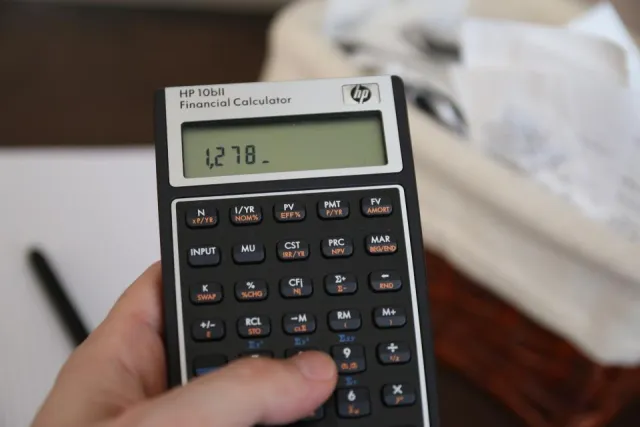
- Equal-principal reducing balance1,278.00
Expanded scale, not zero-based; dots show small differences.
- Lowest displayed value
- 1,278.00
- Highest displayed value
- 1,344.00
Hypothetical cases from the table below, in the stated units. Not market observations, a forecast or a recommended choice. Read the scenario assumptions before comparing.
| Structure | Interest charge (USD) | Total repayment (USD) |
|---|---|---|
| Flat original-balance illustration | 144.00 | 1,344.00 |
| Equal-principal reducing balance | 78.00 | 1,278.00 |
Calculation details
- Flat charge
- 144.00 USD
(1200 * 0.12) - Charge difference
- 66.00 USD
((1200 * 0.12) - 78)
Build a reducing-balance comparison
For an equal-principal illustration, repay 100 monthly and charge 1% each month on the opening outstanding balance. Charges are 12, 11, and successively smaller amounts down to 1. Their total is 78, giving 1,278 of repayment over twelve periods. The difference from the flat illustration is 66 under these assumptions. This comparison uses equal principal to make the balance sequence transparent; a level-payment reducing-balance schedule would have a different interest total. The example does not claim that a 12% quoted annual flat rate equals a 12% disclosed APR or that these terms are available from any lender.
Compare cash flows rather than slogans
For actual borrowing choices, record net money received, every payment amount and date, fees, and any final amount. Compare disclosed APR on an appropriate like-for-like basis, and also compare total cash paid over the intended holding period. A lower-looking numeric rate can be more expensive when it applies to a larger balance for longer. Conversely, a lower total cost may still create payments that the household cannot meet on schedule. The rate label is therefore only one input. The financing arrangement should be understood as a dated exchange of money, which reveals both the charge mechanism and the household's cash obligations.
Supporting references: 2. CFPB: Interest rate versus APR
Examine early repayment separately
A borrower expecting to repay early should obtain the actual payoff method rather than extrapolating from the original rate. Under outstanding-balance interest, earlier principal reduction can reduce later interest. A precomputed structure may treat extra payments or unearned-charge refunds differently. The CFPB explains this distinction in its auto-loan guidance. Ask what amount would close the obligation on a specific date and whether any charge applies. Do not assume a remaining-payment total equals the current payoff, or that extra payments automatically deliver the same interest savings across all structures. Written contract terms and a current payoff statement are more informative than the marketing name.
Supporting references: 1. CFPB: Simple versus precomputed auto-loan interest
Connect the comparison to budgeting
Include the full scheduled payment in the household budget even when part of it returns principal. A household should not choose a structure solely because the first payment appears smaller or the rate sounds familiar. Check total modeled cost, early-payment flexibility, required timing, and whether the amount received actually covers the intended expense after fees. The hypothetical numbers illustrate the effect of the interest base without making a product recommendation. Their value is to show why a rate cannot be interpreted in isolation. Knowing which balance is charged helps the reader ask precise questions and avoid mistaking a percentage label for a complete description of borrowing cost.
Supporting references: 1. CFPB: Simple versus precomputed auto-loan interest · 2. CFPB: Interest rate versus APR
Test another situationA lower-looking rate can charge a larger base
A separate hypothetical case. Its inputs differ from the main worked example above.
A lower-looking rate can charge a larger base
Assume a hypothetical USD 2,000 loan with two half-year periods. One illustration charges a flat 8% annually on the original balance, producing USD 160 of interest for the year. Another charges 5% per half-year on outstanding principal, with USD 1,000 repaid after each period, producing USD 150 of interest. The reducing-balance illustration therefore costs USD 10 less in interest despite the larger-looking annual nominal rate obtained from its periodic convention. These independent schedules exclude fees and use exact period-end payments. The trade-off cannot be read from the rate labels alone because the amount remaining available to the borrower changes through time.
Do not reverse-engineer an early payoff from the headline charge
A flat original-balance illustration describes scheduled charges but does not establish how an actual contract refunds unearned amounts or applies an early payment. CFPB's simple-versus-precomputed guidance distinguishes those mechanisms. Request a dated payoff and identify the remaining principal, accrued amounts, and any adjustment rather than assuming the unused term's charges disappear proportionally. Conversely, do not assume every scheduled future charge must still be paid. The meaningful comparison for an intended early exit is the complete amount required on that date, using the actual contract's method and the same receipt and payment timeline for each alternative.
Supporting references: 1. CFPB: Simple versus precomputed auto-loan interest
Check this case’s calculations
- A lower-looking rate can charge a larger base - result 1
- 160.00 USD
(2000 * 0.080000000000000002) - A lower-looking rate can charge a larger base - result 2
- 150.00 USD
((2000 * 0.050000000000000003) + (1000 * 0.050000000000000003)) - A lower-looking rate can charge a larger base - result 3
- 10.00 USD
(160 - 150)
Limits of this additional case
- The two invented rate conventions do not calculate a regulated APR or a real precomputed-interest refund.
Limits of this analysis
- Flat-rate terminology does not uniquely define contract or refund rules.
- The reducing comparison uses equal principal, not level payments.
- The example does not calculate regulated APR or include fees.
Sources and scope
- CFPB: Simple versus precomputed auto-loan interest
Distinguishes outstanding-balance interest from precomputed charges.
Scope: US consumer education; contractual terms and local rules may differ. Original scenarios are independent illustrations.. Reference accessed 2026-10-06.
- CFPB: Interest rate versus APR
Explains that loan APR incorporates specified fees as well as interest.
Scope: US consumer education; contractual terms and local rules may differ. Original scenarios are independent illustrations.. Reference accessed 2026-10-06.
Illustrative calculations are not forecasts or personal recommendations. Editorial standards